
AI is changing how consumers discover, compare, and buy. For years, digital commerce has been designed around human behavior. Brands optimize websites for search, build product pages for conversion, and create experiences that help people navigate choices. Increasingly, however, the first “reader” of a brand’s digital presence may be an AI agent acting on a human’s behalf.
That shift is at the center of agentic commerce, an emerging category where AI agents help consumers research, evaluate, and eventually complete purchases. As these systems take on more of the buying journey, brands need to make their products, services, pricing, and policies easier for agents to interpret.
In our new white paper, Designing for Agentic Commerce: Why Representation Comes Before Execution, Comcast NBCUniversal LIFT Labs examines the infrastructure and enterprise capabilities shaping this shift. One conclusion stands out: before brands can compete in agentic commerce, they need to become machine-readable.

Your PDF download is ready. Look out for future insights from Comcast NBCUniversal LIFT Labs, featuring startups, technology trends, and innovation in action.
If your file did not download, please click here.
Whitepaper - AI Agents - Mobile
Why the Market Is Validating Agentic Commerce
Agentic commerce is still early, but the market is already testing which approaches are likely to work. Consumer-facing AI systems are becoming more capable of handling multi-step digital tasks, from interpreting intent to coordinating actions across platforms. At the same time, major technology and payments companies are building infrastructure that moves agents closer to commerce execution.
Two developments are especially important. Agent-native systems such as OpenClaw show growing consumer interest in delegating complex, long-running digital tasks to AI systems rather than using them only for conversational answers. Meanwhile, companies including Google, Shopify, Stripe, Visa, Cloudflare, and OpenAI are advancing protocols that support agent discovery, authentication, and payment.
The market is also beginning to show where enterprise control matters. Our white paper examines early examples where platform-owned checkout introduces friction, while merchant-controlled models are better positioned to preserve conversion, customer data, and trust. For brands, the takeaway is not to wait for a single commerce surface to win, but to make the underlying offer clear enough for agents to interpret wherever the interaction takes place.
User Experience vs. Agentic Experience
Agentic experience, or AX, is the process of optimizing a brand’s digital presence for AI agents. Traditional user experience is built around human cognition, prioritizing design, navigation, visual hierarchy, and persuasive copy that helps people make decisions.
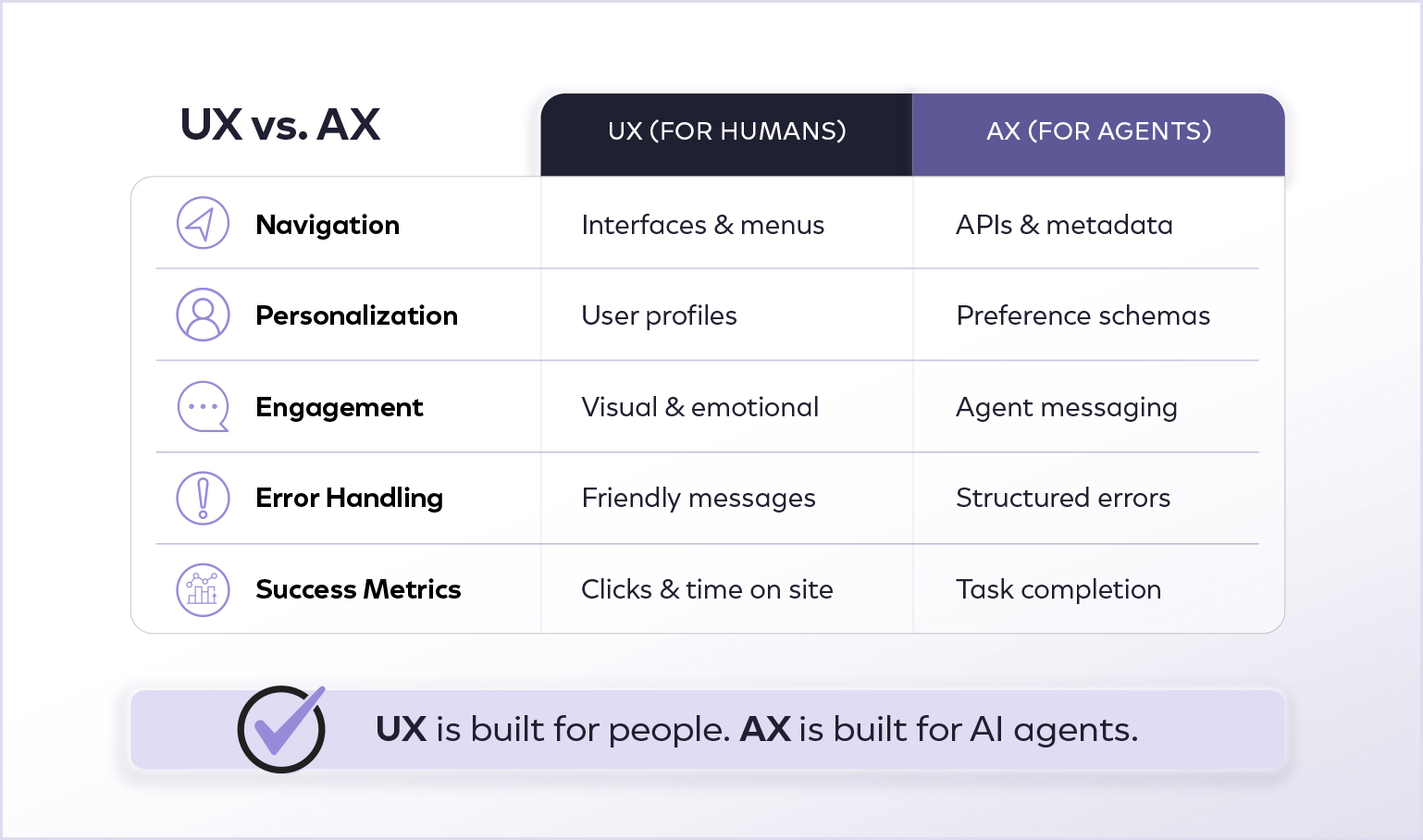
Agents operate differently. They rely on structured, consistent product data, explicit pricing logic, clear policies, and information they can compare reliably. They can also process far more information than a person scanning a product page, reducing the need to compress every detail into short, persuasive copy. In that sense, AX is less about how value is presented and more about how value is represented.
That does not mean UX goes away. Human-facing design still matters for trust, brand building, and complex decision-making. AX adds another layer: information structured so an agent can determine what is being offered, who it applies to, how it compares with alternatives, and whether it matches a consumer’s preferences. If an agent cannot reliably understand an offer, that offer may never make it into the consideration set.
The Startup View from the Frontier
The startup ecosystem offers a useful view into how quickly this category is expanding. Profound and Bluefish are helping enterprises understand how they appear in AI-generated answers and how marketing teams can adapt to an AI-mediated discovery environment.
Other companies are working further down the stack. Channel3 focuses on structuring and normalizing product catalogs so AI systems can evaluate offerings more reliably, while Scrunch has explored agent-oriented digital twins of brand websites, routing AI traffic to simplified, machine-readable versions while preserving the human-facing experience.
Envive surfaces recurring consumer intents, objections, and comparison criteria from conversations taking place across chatbots, social media, and online forums. Auxia, a Comcast NBCUniversal LIFT Labs portfolio company, demonstrates how AI can help brands adapt value propositions across different customer contexts.
These companies are tackling different parts of the same challenge. Discovery matters, but so do the data, policies, product structures, and personalization systems behind it. A brand may understand how it appears to LLMs and agents, but agents still need reliable information underneath that experience to compare and recommend what the brand offers.
Personalization Becomes the Consumer Interface
AX also changes how brands can think about personalization. Today, many companies still personalize through broad audience segments based on demographics, behaviors, or inferred intent. In an agent-mediated buying journey, the unit of personalization can move closer to the individual request.
An AI assistant might know that one consumer is comparing internet plans for a household with multiple remote workers, heavy gaming usage, streaming needs, and sensitivity to fees. Another consumer may care most about reliability, equipment simplicity, and the ability to bundle connectivity with entertainment. These are different buying contexts, even if the consumers fall into the same traditional marketing segment.
For an agent to make that distinction useful, it needs structured information it can map to the consumer’s stated preferences. Brands therefore need to express not only what they sell, but also the needs, use cases, and conditions associated with each offer. When product attributes, eligibility rules, policies, and value propositions are structured clearly, agents can make more precise matches between offers and consumer context, making AX both a defensive requirement and an offensive opportunity.
What Businesses Can Do Now
Preparing for agentic commerce does not require rebuilding an entire digital commerce infrastructure overnight. The first step is to identify where existing information is difficult for agents to interpret.
Businesses can begin by auditing their digital presence through an AX lens:
- Are offers clearly defined?
- Is pricing easy to understand?
- Are promotions, fees, and eligibility rules explicit?
- Are product and service attributes consistent across systems?
- Are policies written in ways machines can parse?
- Can consumer preferences be captured and applied consistently?
- Are important details trapped in PDFs, images, scripts, or disconnected databases?
From there, companies can prioritize a few foundational capabilities: machine-readable offers, explicit policy expression, normalized product or service attributes, and preference capture mechanisms that help agents match offerings to consumer needs.
This work can also improve the human customer journey. Clearer offers, cleaner product data, and more consistent policy language benefit sales, support, marketing, and customer experience teams, not just AI systems.
Why Services Are More Complex
Agentic commerce is likely to mature unevenly across categories. Standardized consumer goods are easier for agents to evaluate because they tend to have fixed prices, clear attributes, and relatively simple fulfillment. Services introduce more conditional logic.
Connectivity, entertainment, financial services, insurance, healthcare, and travel can depend on location, eligibility, bundles, promotions, usage needs, contractual terms, and trust. For companies whose value is defined through combinations of plans, services, devices, serviceability, and offers, becoming machine-readable is more complex.
The preparation requirement, however, remains the same: agents need to understand what is being offered before they can evaluate or recommend it. Companies do not need to wait for one agent platform, commerce surface, or payment protocol to dominate before beginning this work. They can start with the information and systems they already control, making products, services, pricing, and policies easier for machines to interpret accurately.
The New Commerce Gatekeeper
Agentic commerce does not eliminate the need for strong brands, thoughtful design, or trusted customer relationships. It introduces another audience into the buying journey, requiring brands to remain compelling to humans while also becoming legible to machines.
A strong brand story cannot do its job if the underlying offer is difficult for an agent to interpret. A promotion may not surface if eligibility is ambiguous, and a relevant service may be overlooked if the attributes that make it valuable are difficult to compare. This is why AX is an important starting point for enterprises preparing for agentic commerce.
Checkout models, payment protocols, agent decisioning, and commerce surfaces continue to evolve, but representation comes first. In a delegated commerce economy, being understood by AI may be just as important as being chosen by consumers.
